|
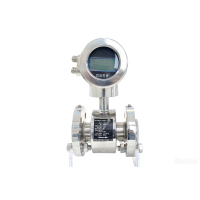
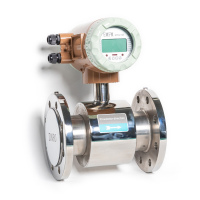
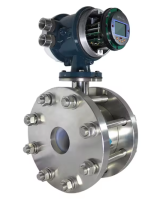
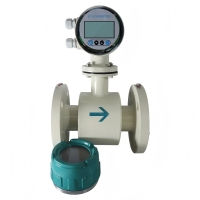
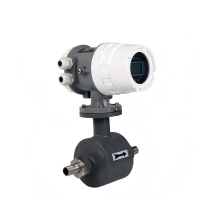
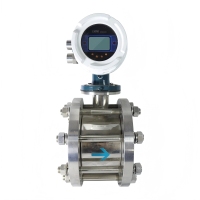
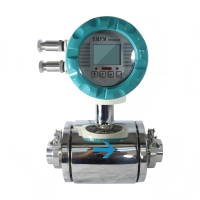
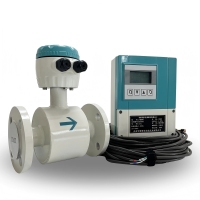
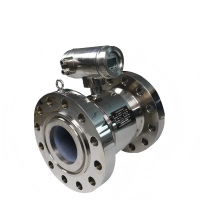
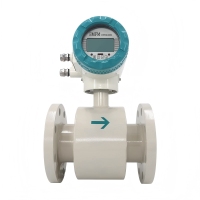
Stainless Steel Electromagnetic Flowmeter
Collect
WORKING PRINCIPLE
Based on Faraday's Law of Electromagnetic Induction, a pair of detection electrodes is mounted on the tube wall perpendicular to both the axis of the measuring tube and the magnetic lines of force. When the conductive liquid flows along the axis of the measuring tube, it cuts the magnetic lines of force to generate an induced electromotive force (EMF), which is detected by the two electrodes. The sensor transmits the induced electromotive force E as the flow signal to the converter. After a series of processes including amplification, conversion, filtering and digital processing, the converter displays the instantaneous flow and cumulative flow on a backlit dot-matrix liquid crystal display (LCD). TECHNICAL PARAMETERS
PRODUCT ADVANTAGES
1.The electromagnetic flowmeter sensor features a simple structure with no moving parts in the measuring tube and no components that obstruct fluid flow. 2.It can measure contaminated media, corrosive media, and liquid-solid two-phase flow. 3.During measurement, it is not affected by temperature, viscosity, density, or conductivity (within a certain range) of the measured medium. 4.The output is directly proportional to the average flow velocity and is independent of the flow state (laminar or turbulent) under symmetrical flow distribution. 5.With no mechanical inertia and a fast response, the flowmeter can measure instantaneous pulsating flow as well as flow in both forward and reverse directions. 6.Industrial electromagnetic flowmeters are available in a wide range of sizes. APPLICATION FIELD Electromagnetic flowmeters are widely used in petroleum, chemical, metallurgy, food, power, papermaking, water supply and drainage, petrochemical, and medical industries.
Related Products
|