|
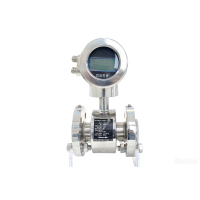
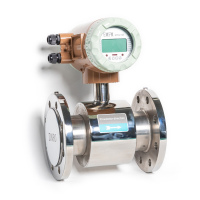
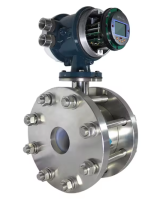
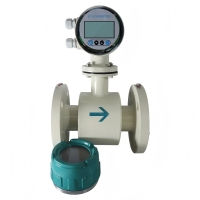
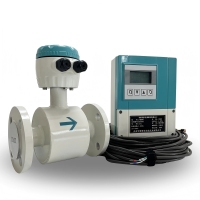
Flange-type electromagnetic flowmeter
Collect
Product Description
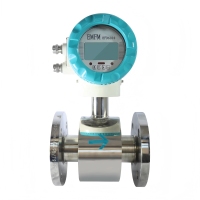
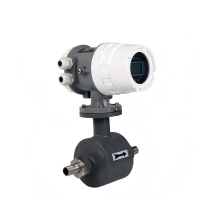
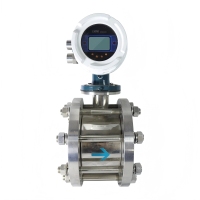
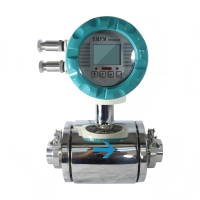
INTRODUCTION The electromagnetic flowmeter complies with the standard JB/T9248-2015 《Electromagnetic Flowmeters》. It is an inductive instrument for measuring the volume flow of conductive media. While performing on-site monitoring and display, it can output standard current signals for recording, regulation and control purposes, realizing automatic detection and control, as well as long-distance transmission of signals. It can be widely used for the flow measurement of conductive liquids in industries such as tap water, chemical industry, coal, environmental protection, textile, metallurgy, papermaking, etc. It has obtained the explosion-proof certificate issued by the National Quality Supervision and Inspection Center for Explosion-Proof Electrical Products, with the explosion-proof mark EXD11CT6, which is suitable for liquid measurement in various explosive environments. WORKING PRINCIPLE Based on Faraday's law of electromagnetic induction, a pair of detection electrodes is installed on the tube wall perpendicular to the axis of the measuring tube and the magnetic field lines. When the conductive liquid moves along the axis of the measuring tube, it cuts the magnetic field lines to generate an induced electromotive force (EMF), which is detected by the two detection electrodes. The value of this induced EMF is proportional to the flow rate, and its formula is: E = KBVD Where: E – Induced electromotive force; K – Coefficient related to magnetic field distribution and axial length; B – Magnetic induction intensity; V – Average flow velocity of the conductive liquid; D – Electrode spacing; (inner diameter of the measuring tube) The sensor transmits the induced electromotive force E as a flow signal to the converter. After amplification, conversion, filtering and a series of digital processing, the instantaneous flow and cumulative flow are displayed on a dot-matrix LCD with backlight. The converter is equipped with 4~20mA output, pulse output and frequency output, as well as communication interfaces such as RS-485, and supports HART and MODBUS protocols. PRODUCT ADVANTAGES 1. The electromagnetic flowmeter sensor has a simple structure, with no moving parts in the measuring tube and no throttling components that hinder fluid flow; 2. It can measure the flow rate of dirty media, corrosive media and suspended liquid-solid two-phase flow; 3. During the measurement process, it is not affected by the temperature, viscosity, density and conductivity (within a certain range) of the measured medium; 4. The output of the electromagnetic flowmeter is only proportional to the average flow velocity of the measured medium, and has nothing to do with the flow state (laminar flow or turbulent flow) under symmetrical distribution; 5. The electromagnetic flowmeter has no mechanical inertia and is sensitive in response. It can measure instantaneous pulsating flow and also flow in both positive and negative directions; 6. The industrial electromagnetic flowmeter has a wide range of caliber selection. TECHNICAL PARAMETERS
APPLICATION FIELD Electromagnetic flowmeters are applied in industries such as petroleum, chemical industry, iron and steel, food, electric power, papermaking, metallurgy, water supply and drainage, petrochemical industry, medical treatment, etc. INSTALLATION PRECAUTIONS Notes: 1. Install in a place without vibration or strong electromagnetic fields (such as near large motors and frequency converters); 2. Vertical installation is preferred. If horizontal installation is required, install it at a low position, not at the top of the pipeline, to ensure full pipe and prevent air bubbles; 3. Straight pipe section requirement: It is best to ensure 10 times the pipe diameter at the front and 5 times the pipe diameter at the rear; 4. For welding-type installation, do not weld the instrument directly to avoid damaging the flowmeter; 5. Try to ground the shell, and ground the shielded wire at one end; the grounding point must not share the same ground with strong electricity; 6. If for the convenience of maintenance, the installation position should be selected to meet the maintenance requirements. At the same time, a bypass pipe can be installed, so that the fluid can pass through the bypass pipe in case of failure; 7. Avoid places exposed to direct sunlight and high temperature, and do a good job in waterproof and moisture-proof treatment; 8. Other requirements that should be considered: signal wiring should not be routed together with strong electric lines.
Related Products
|